
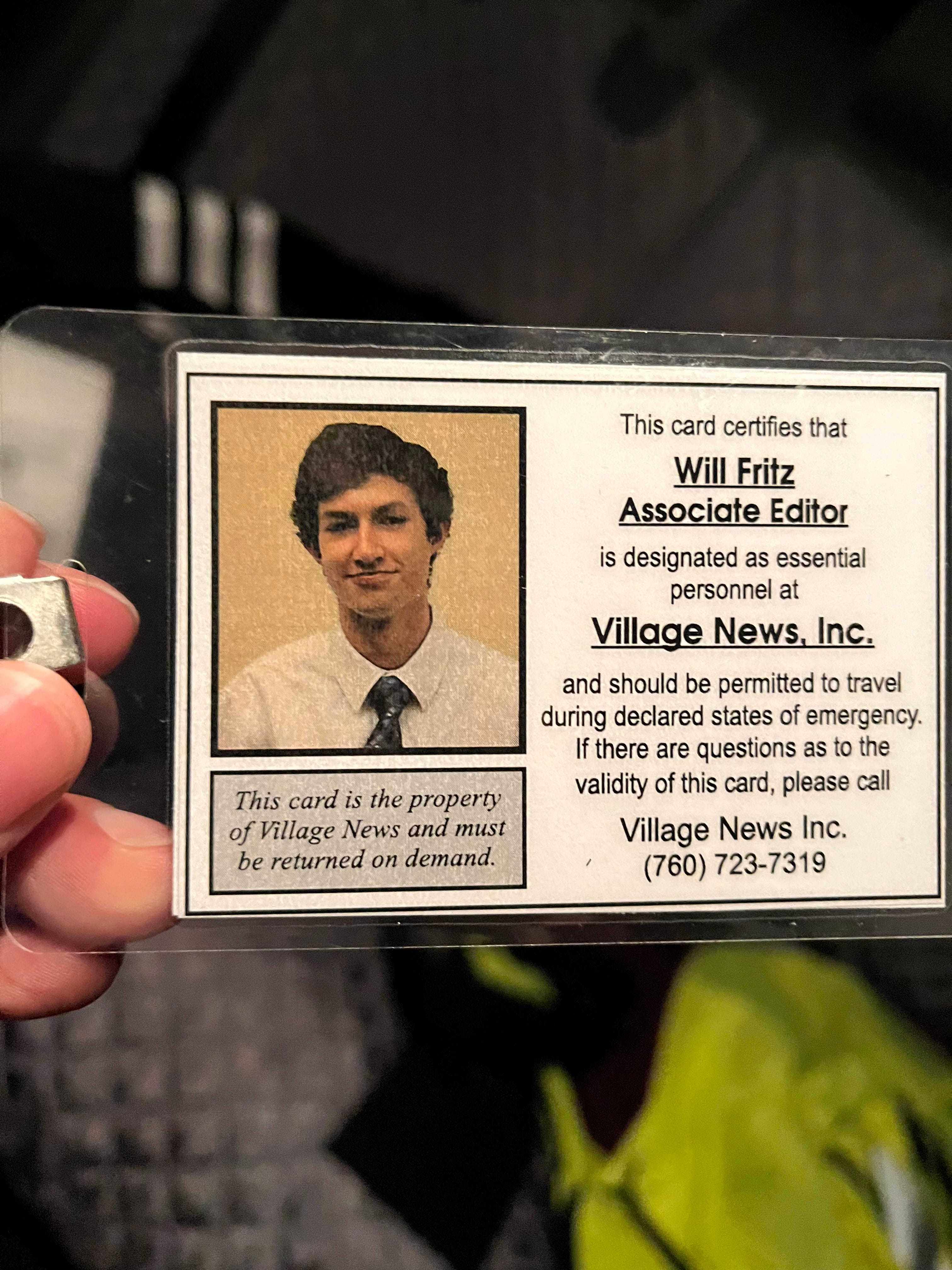
It may surprise those who know me now, but I once worked for a local news group owned by a woman who was so gripped by rightwing conspiracy theories that on Jan. 6, 2021, I had to beg her to take down a wire story that she personally edited to suggest “Antifa” were behind the unfolding attack on the United States Capitol.
At some point prior to that, I had considered that particular collection of weekly newspapers to be the closest thing to respected, on-the-ground reporting that we had in our rural-exurban region straddling the border of Riverside and San Diego counties in Southern California. We may not have been a big metropolitan daily, but everyone read us and knew us personally.
Some might expect that a young gay Latino journalist might not be a good fit for fair coverage of an area where nearly every single city council and school board was dominated by Republicans, but our personal political beliefs really didn’t matter, at least for a time. Everyone knew my reporting would call out corruption and reward virtue, regardless of party (it helped that these local governing bodies were technically nonpartisan even if we all knew where each elected official stood). Some liberal Fallbrook school board members scorned me, some conservative Murrieta city council members loved me. So it goes.
Things were already changing a bit by this time, a few years after Donald Trump’s first election to the presidency, but the true shift happened when the COVID-19 pandemic began. Suddenly, as the president insisted on national television that the virus was “just a cold,” objective medical facts did not matter. Whether you listened to experts and wore a mask, or took one particular city council candidate’s advice and removed what she called a “face diaper,” was suddenly an indication of whose side you were on. Where before it was perhaps guessable what my beliefs were, but never explicitly revealed, I was now making a statement every time I showed up anywhere wearing an N95.
Just as suddenly, perhaps driven a bit mad by weeks and months of isolation – as we all were in one way or another – my publisher’s editorials shifted from a bit too reactionary for my tastes to open flirtation with racism and various far-fetched fantasies. In my first month at that job I was allowed to investigate a local high school’s bungled response to anti-Black messages (in 2019, most people still agreed that racism was bad). By my final months I was demanding to be excluded from working on a story that explicitly defended a couple accused of racist actions and even granted them anonymity.
Which brought me to that January day when I sat in my bedroom in Escondido watching pro-Trump rioters, some of whom I had literally met and interviewed in Arizona two months prior, ransack our nation’s Capitol while my boss insisted through my iPhone speaker that leftist agitators were actually responsible. For pointing out what I knew to be fact, I was told I was biased, though she did eventually relent and pull down the Associated Press report she heavily edited – I likely would have quit and gone to work at McDonald’s again had she not.
I didn’t pick a side. The truth did. Fairness did. Objective reality did.
Six years later, I’m in a journalism master’s program in a foreign country, here not for lack of experience but explicitly because political developments in my homeland have made me so uneasy that, at best, I felt I needed to leave to get some perspective, and at worst, I feared the stage had been set for genuine press censorship in the coming years.
What does that make me? Am I a journalist? Or an activist?
I’m still on the side of the truth. But what do you do when 30-40% of the population no longer believes in the truth anymore? Do you coddle and reassure them that their false beliefs are perfectly fine in the hopes they won’t point their fingers at you and accuse you of being “fake news”? Or do you confidently repeat what you know to be true, their opinions be damned?
For better or worse, I’ve always preferred the latter approach. The gravest journalistic sin of the past decade of Trumpism has been, in my view, the reluctance to call a spade a spade — the refusal to identify Trump as a uniquely undemocratic and authoritarian force until it was far too late. Or perhaps even worse was this: the rehabilitation of his image as a serious political candidate after he tried to illegally hold on to power after losing the 2020 election.
This does not mean that all conservative voices and viewpoints are suspect. It does not mean we should not listen to what those who disagree with us have to say. But it does mean we should not debase ourselves and ignore the obvious to avoid criticism, especially considering that those who will deride us as “biased” will do so regardless of how we contort ourselves. Reactionaries do not stop referring to The New York Times or CNN as “the liberal media” when those outlets attempt to accommodate their false beliefs. They simply move on to other reasons to deride them, hoping to see how far away from the truth they can push them.
I will always describe myself as a journalist, but if speaking the truth causes some to view me as an activist then so be it.
Welcome to my world. I have been trying to launch an overwhelmingly obvious knowledge Renaissance that is explaining mystery after mystery after mystery and people only have two choices they could accept that this is the theory of everything and is uniting all of these things that have to be part of each other's story, or you have no answer and what these idiots I'm saying and who claim that they cannot explain 95% of the universe, as they carry on supposedly slowly making progress. It's a huge crime and I can't seem to get a reporter to crack it or a publisher to publish it. What would you think in my position? I'm trying to save civilization and civilization is full of idiots. Why wouldn't we elect a moron president who's trying to destroy the economy. It's so bad people wish he'd go back to his stupid tariffs instead of what he's doing now!